
Strategic Overview: UNITS Moving & Portable Storage
Built by GEN Systems. Run on Business Hub OS. At home in FlowState.



Prepared November 11, 2026 · A read of the public record: the network you built, where it leaks, and the system we would put around it
Your own comparison page says it plainly: every time you call one of our locations, you will be speaking with friendly and knowledgeable staff who know your area. This overview is about the hours when nobody is there to keep that promise, and what to do about them.
Watch: the overview in ninety seconds
The short version: the company, where it leaks, the fix, the working demo we already built (now with a page for every container, a renter portal, and QR codes on the yard), and the pilot we are proposing. Runtime 1:31.
Video ads we made for UNITS
Three short spots in the UNITS voice, built for social: six seconds each, made to stop a scroll and start a conversation about your next move.
We need to talk about your unit
Big moving energy.
Do you have a BIG unit?
Make room for your next move.
Nice package.
We knew you'd notice.
01The network you built
- Founded in 2004 by Michael McAlhany, American owned and operated, now run as a franchise network by UNITS Franchising Group out of Daniel Island, South Carolina.
- More than 70 locally owned centers, each with its own market site, its own local pages, and its own city landing pages. The Minneapolis operation alone carries 34 city pages across the Twin Cities.
- A real product edge: the ROBO-UNIT delivery system that places containers in tight spaces and lifts level, the ETRACK securing system, translucent-roof containers in 12 and 16 foot sizes, ground-level loading, and storage at your own climate-controlled centers.
- A serious content engine: roughly 500 published articles, comparison pages against your national rivals and against traditional self-storage, a dozen business verticals with their own pages, and paid-search landing pages.
- Proof your customers love the human part: a 4.9 star brand rating on Trustpilot, where review after review names a local staff member and praises the phone call, the callback, and the care. People are not buying a steel box. They are buying the local person who answers.
02Where it leaks
The promise ends at closing time
Locations publish business hours, and outside them there is no capture layer at all: no chat on the national site, no text-back when a call is missed, nothing answering at night or on weekends, which is exactly when moving and storage get researched. Your national rivals staff call centers around the clock. The caller you earned with all that marketing gets their answer first.
The quote leaves your website
Every Get a Quote path hands the visitor to a separate portal, and that portal greets a direct visit as an account login. Nothing on your site captures the visitor first: no name, no number, no text-back if they stall at the handoff. The highest-intent click you own is the one place a lead can vanish without a trace.
Three numbers, one location
Your Minneapolis location circulates three different phone numbers across its own website, its Google listing and ads, and its review profile, and the facility suite number disagrees between sources. Attribution is unmeasurable, local ranking signals split, and directory data has drifted so far that an AI lookup now attaches one of those numbers to a different business name entirely.
Two reviews in your home market
The brand rating is 4.9 stars. The Minneapolis location profile a Twin Cities shopper actually checks shows 3.8 stars from 2 reviews, with no recent review invitations sent. For a service that enters people's homes and holds everything they own, local proof is what converts, and in this market it is nearly empty.
Full audit with sources: the findings above come from your website, your listings, and your review profiles, read on November 11, 2026. Nothing here is guessed; the complete audit is available on the call.
03The opportunity
UNITS does not have a traffic problem. Seventy local sites, hundreds of articles, and city-level pages already pull demand in. The money is lost in the gap between a person raising their hand and a person being answered, after hours, at the quote handoff, and in the follow-up that never happens because the owner is out driving a truck. Close that gap and the same marketing produces more booked containers, and the brand promise your reviews describe becomes true at 9 PM on a Sunday, not just at 10 AM on a Tuesday. The right first move is one market, fully wired, measured against its own numbers, then the pattern rolls to the network.
04What we would build
An always-on local receptionist
An AI receptionist on each location's own number, answering in the location's name around the clock, taking quote details, and booking the follow-up. The moment a call is missed, the caller gets a text back from that same local number. Your staff still answer all day; nobody ever hits voicemail again.
Quote capture before the handoff
A first-party quote start on your own pages (name, number, ZIP, dates) that texts the customer immediately and then passes the full detail into your existing portal. A stalled handoff becomes a conversation instead of a lost lead.
One inbox per location
Calls, texts, web chat, social messages, and quote notifications in a single screen the owner and team actually see, with AI drafting the replies. No more messages sitting unseen in a system nobody opened that day.
A CRM that follows up like you would
Every quote request lands in one pipeline per location, with an automatic follow-up cadence by text and email until the job books or closes. Owners see every open quote at a glance, including the ones that came in overnight.
A review engine per location
A systematic request after every completed job, routed to Google and your review profiles, with help answering every review that lands. Built to take a 2-review profile to a market-leading one within a quarter, using the service your customers already praise.
One number, one identity
A cleanup pass per location: one published, call-tracked number, the same address everywhere it appears, and the website, Google, and review profiles aligned to it. Attribution becomes measurable and the directory drift ends.
The next layer, already built as a working demo
Since the first draft of this overview, we built the next layer on the same demo system. None of it is a sketch: each piece below is live in the demo and runs on the same records as the console and the yard map in the video above.
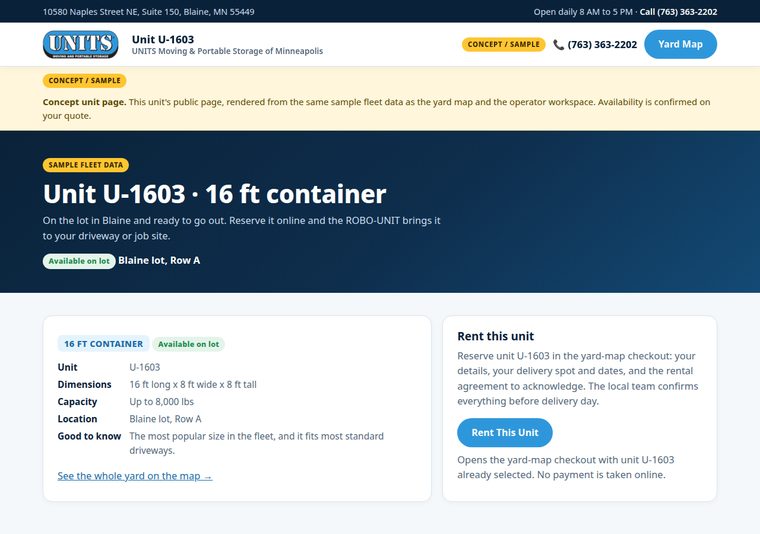
A page for every container
Every unit gets its own shareable page: size, what fits, features, and whether it is available right now. A rep on the phone texts the renter the exact container instead of describing it, and a unit that is already out still captures the next renter on a waitlist instead of ending the conversation.
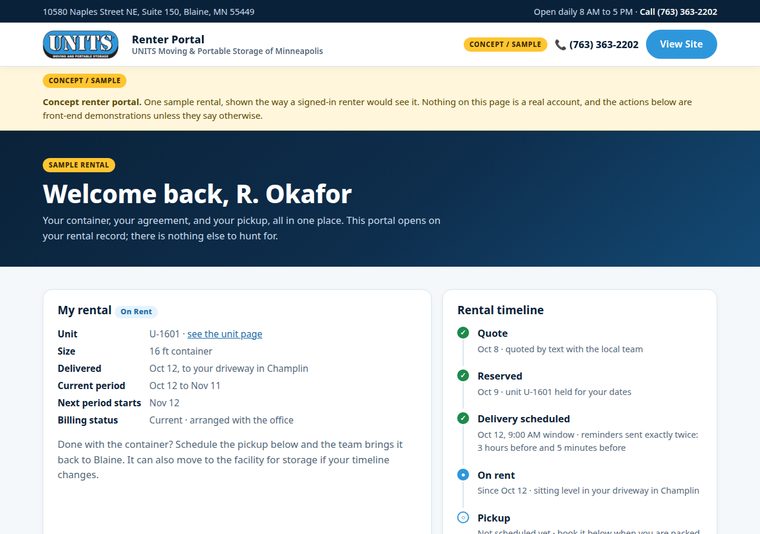
The renter portal
The renter's own view of their rental: its status, the condition photos taken on delivery day, the agreement, and a message box to the office. Pickup scheduling lives there too, and the delivery reminders show on the renter's timeline exactly as the office sends them: one three hours before, one five minutes before.
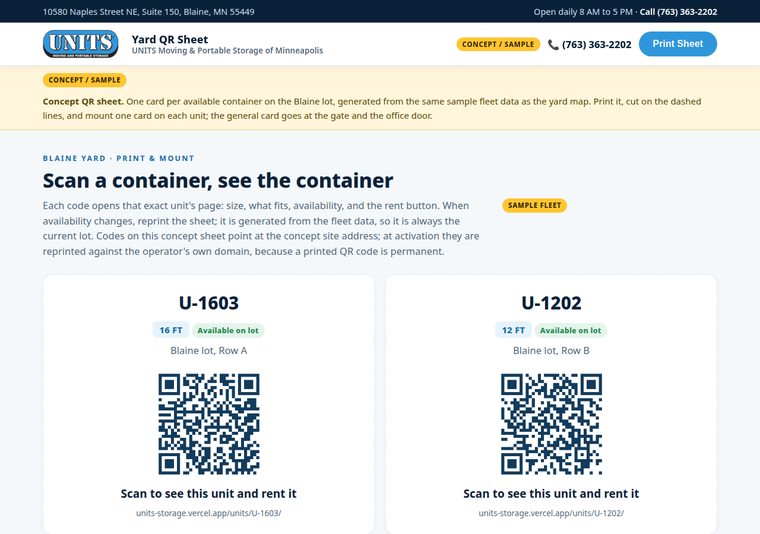
QR codes on the yard
A printed code on the unit in front of you opens that unit's page: size, what fits, availability, and a rent button. A drive-by or an after-hours walk-up becomes a quote with no phone call, which is the closing-time leak from section 02 moved to the physical yard, and closed the same way.
Review capture at pickup
The review request becomes a closing step of the job, not an afterthought: when the container is collected and the job closes, the ask goes out to Google and the review profiles, and every reply is drafted for a human to approve. The review engine above stops depending on anyone remembering.
Referral links for partners
Property managers, realtors, and restoration companies meet movers first. Each partner gets a link stamped with their name, so anyone who arrives through it lands as a lead credited to that partner, and the console shows exactly what each link produced. Terms stay the operator's to set.
Claimed and current on Google
The location's Google Business Profile, claimed and kept current: hours, services, photos, and the same name, address, and number as the website. It is the listing a Twin Cities shopper checks first, and the same claimed facts are what AI assistants repeat when someone nearby asks where to store.
05The first move: a Twin Cities proof case
- Why Minneapolis: one owner-operator, one facility in Blaine, 34 city pages already pulling local demand, and the thinnest local systems in the network to improve on: three circulating numbers, a 2-review profile, and a local social page with 84 followers. Every weakness in this overview is visible there in miniature, which makes it the perfect measured pilot.
- What the pilot proves: after-hours calls answered and texted back, quote requests followed up automatically, review volume climbing, and one clean set of numbers across every listing. Ninety days of that, in one market, is the evidence base for a network conversation with the franchise group.
- What it asks of the operator: one working session to set the local facts (hours, service area, quote rules), and approval of the words the system uses. We build and run the rest.
Where this can go
The same system does not have to stop at one yard. A landowner with a commercially zoned parcel can host a small satellite lot: a few containers on a level pad, signed and QR coded like the Blaine yard. The system approves the site before anything is promised, tracks every unit placed there, and splits the revenue with the host, while rentals stay with the operator. Capacity grows parcel by parcel instead of lot by lot, starting in the Twin Cities with one partner and moving market by market, built on loyalty rather than land purchases.
06Next step
A short call with Anton Hocking, founder of Business Hub OS. Bring your hardest questions about how this would run inside a franchise system and what it would mean for a single location. We will walk the full audit, show the systems working live, and scope the Twin Cities pilot together. No pitch deck, no pressure: the record above either earns the conversation or it does not.
Book the call
Pick any time that suits you. The full audit and the pilot scope are ready to walk through.
Book a Call